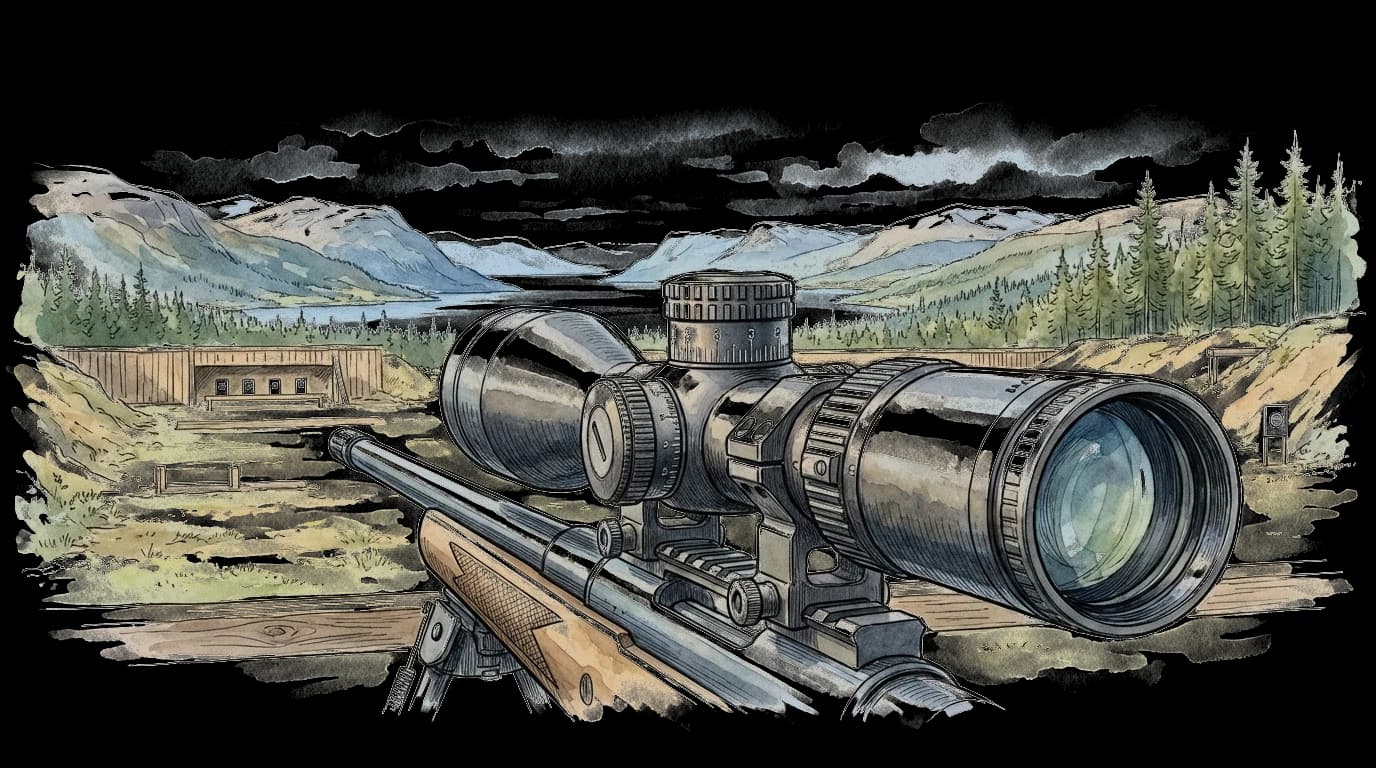
Ballistic tables
Ballistic tables show bullet drop at various distances. Here's how to use them.
A ballistic table shows how much the bullet drops at various distances, and how many clicks you need to adjust on your scope to compensate.
Why you need this: The bullet follows an arc. Even if you aim directly at an animal at 200 meters, the bullet hits lower than the point of aim because gravity pulls it down along the way.
How to read a ballistic table: The table shows distance (e.g., 100, 150, 200, 250, 300 m), bullet drop in cm, and the number of clicks up/down on the scope.
Example for 6.5x55 with 140 gr bullet, zeroed 4 cm high at 100 m: 100 m: +4 cm (bullet hits above point of aim) 150 m: +3 cm 200 m: 0 cm (bullet crosses the line of sight) 250 m: -8 cm 300 m: -22 cm
This means you can aim center mass on a roe deer out to 200 meters without thinking about holdover. At 300 meters, you need to aim above the back.
Most scope manufacturers specify click values (MOA or MRAD). 1 MOA = approx. 3 cm at 100 m. 1 MRAD = approx. 1 cm at 100 m.
Create your own ballistic table with free tools like Strelok (app) or JBM Ballistics (web). You'll need: caliber, bullet weight, muzzle velocity, scope height above bore, and zero distance.
Memorize your table for the distances you typically hunt at. Stick it on the stock or behind the scope cap.
Find Hunting Grounds
Create a free account and find hunting grounds across Norway.